 THERMOStart your project
BUILDERS FIRSTSOURCE · ISSAQUAHGet a local Maximo consultation
Project guidance · Installation & care
Installation thatremoves guesswork.
Thermally modified wood is more dimensionally stable than untreated wood, but the finished assembly still depends on correct storage, ventilation, fastening and coating decisions. Use this guide to plan the work, then confirm the current instructions for the selected Maximo profile and project conditions.
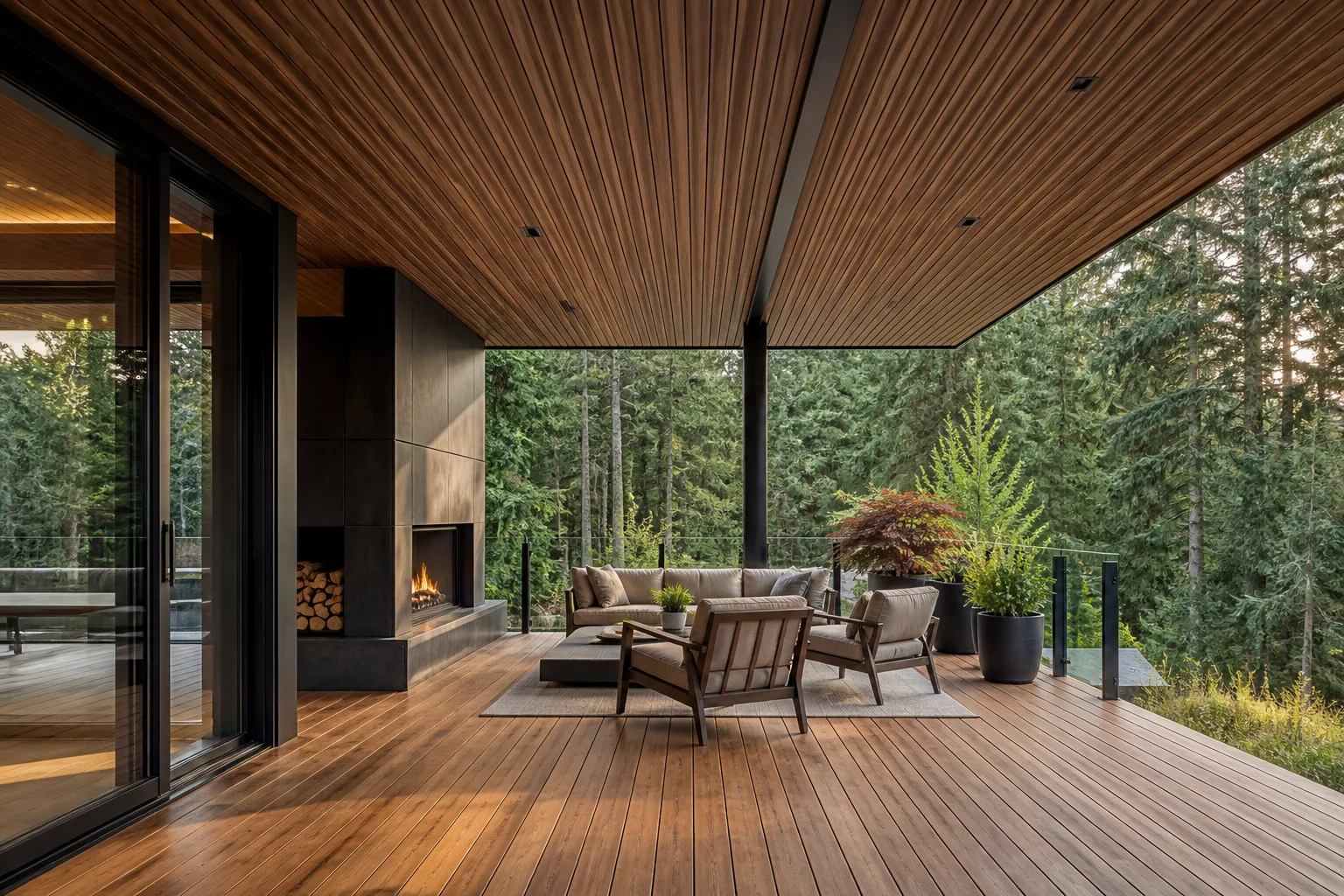
INSTALLATION SYSTEMRainscreen · stainless steel · sealed cuts
01
Project detail
Jobsite Storage & Acclimation
Keep boards dry, supported and ventilated before installation
Thermal modification lowers the wood’s equilibrium moisture content and reduces its response to humidity. Uninstalled boards can still absorb surface moisture, so bundles should remain covered, elevated from the ground and protected from standing water.
Support boards evenly on level dunnage and keep air moving around the bundle. Do not place the material directly on damp concrete, wet framing or soil, and avoid trapping wet boards inside unventilated plastic.
Maximo’s siding guide calls for at least 48 hours of acclimation at the installation location. Keep the material under cover during this period and inspect it before layout.
Before installation
Keep the boards clean, dry and evenly supported. If material arrives wet or damaged, pause installation and contact the supplier before fastening it to the building.
02
Project detail
Ventilated Siding Assemblies
Provide drainage, drying and the correct supporting structure
For Maximo siding, the current installation guide calls for furring strips at least 3/4 inch thick and spaced no more than 24 inches on center. The wall assembly must provide a continuous path for drainage and ventilation behind the boards.
The furring direction depends on the cladding orientation. Vertical siding may require a cross-batten or other approved strategy so horizontal supports do not block vertical drainage. Coordinate insect screening, flashings and transitions with the complete wall design.
Soffits, ceilings and decking use different support and ventilation details. Confirm the selected profile’s intended application and the project-specific requirements before installation.
| Condition | Maximo guidance | Confirm for the project |
|---|---|---|
| Exterior siding | Furring at least 3/4 inch thick and no more than 24 inches on center | Water-resistive barrier, flashing and ventilation path |
| Openings and grade | Maintain the guide’s clearances and gaps around openings | Local code, site drainage and trim details |
| Vertical siding | Keep drainage and airflow continuous behind horizontal supports | Approved cross-batten or alternate assembly |
| Soffits and decking | Use the instructions for the selected profile and application | Support spacing, ventilation and loading requirements |
03
Project detail
Fasteners, Sub-framing & Spans
Select corrosion-resistant fasteners for the species and application
Maximo’s exterior installation guidance specifies stainless steel fasteners to reduce corrosion and staining risk. Fastener type, length and spacing depend on the profile, species, substrate and exposure.
The guide emphasizes screw fastening for Thermo Clear Radiata and Scandinavian Thermo profiles. Thermo Ayous may be installed with suitable stainless steel nails where the current profile instructions allow it.
Pre-drilling is recommended for all fasteners because thermally modified wood can be more brittle than untreated lumber. Take particular care at board ends, edges and dense profiles.
Fastener selection
Use exterior-grade stainless steel fasteners and verify the current Maximo schedule for the chosen species and profile. The project designer should confirm substrate penetration and any coastal or structural requirements.
04
Project detail
Machining, Field Cuts & End Sealing
Use sharp tools and protect every exposed field cut
Thermally modified boards machine cleanly when tools are sharp and the workpiece is fully supported. Test the setup on an offcut, use a steady feed rate and avoid impacts that can split thin edges or detailed profiles.
Treat field cuts, notches and exposed ends according to the selected finish system and the current Maximo instructions. Cut-end protection helps limit localized moisture uptake and keeps the finish appearance consistent.
05
Project detail
Maintenance & Natural Weathering
Choose between natural graying and color retention
Like other natural wood, uncoated thermally modified wood changes color under ultraviolet light and weather exposure. The surface can move toward a silver-gray appearance while the underlying thermal modification remains part of the material.
To retain the original brown tone, use a compatible pigmented exterior coating and follow the coating manufacturer’s preparation and maintenance instructions. Inspection and recoating frequency vary with exposure, orientation, color, assembly and local conditions.
| Finish approach | Ongoing care | Expected appearance |
|---|---|---|
| Natural weathering | Clean and inspect; address staining or biological growth promptly | Gradual silver-gray surface color |
| Pigmented exterior finish | Inspect and recoat as the finish manufacturer directs | Longer retention of the selected brown tone |
| Custom coating system | Confirm compatibility, coverage and renewal procedure | Project-specific color and sheen |
Profile & Installation Planning
Read the profile before
choosing the fastening method.
The Maximo catalog includes square-edge, V-joint, nickel-gap, fluted and end-matched products. Joint geometry and fastening vary by SKU, so this simplified view should be used as a planning aid—not as a scaled CAD detail.
Profile-defined joint and reveal
Reveal width and joint geometry depend on the selected profile. Confirm the current dimensioned cross-section rather than measuring this illustration.
Fastening is assembly-specific
Confirm fastener material, gauge, length, edge distance and placement for the selected profile and substrate. Concealed fastening should not be assumed for every SKU.
End match only where listed
Only the cataloged Thermo Ash 1x6 Plus and 5/4x6 products are identified as End Match. No universal off-framing rule or fixed waste reduction is claimed.
Keep the project moving
Choose the detail
you need next.
Where to buy in Issaquah
Builders FirstSource Issaquah
Catalog available by consultation. Contact the Issaquah team to confirm availability, sample kits, and lead time for your selected Maximo profile.
Issaquah, WA 98029
(425) 391-8000
Monday–Friday, 7:00 AM–4:00 PMDealer information verified August 31, 2026. No in-stock claim is made on this site.
Request a local quote
Put this profile
on your project.
Tell us what you are building. Our team will review your wood selection and contact you to coordinate a Maximo consultation with Builders FirstSource Issaquah.
Frequently Asked Questions
Common project
questions
Is pre-drilling always required when fastening thermally modified wood?+
Maximo recommends pre-drilling for all fasteners. The appropriate bit, fastener and edge distance depend on the selected species and profile, so use the current product instructions for the final schedule.
Can I install Maximo Thermo siding directly over OSB or plywood without furring?+
Maximo’s siding guide calls for furring strips at least 3/4 inch thick to create ventilation behind the boards. The complete wall assembly, including the water-resistive barrier and flashing, should be approved for the project and local code.
What happens if I don’t seal the field cuts with end-grain sealer?+
Unsealed end grain allows capillary moisture absorption during rain events, which can cause localized swelling, discoloration, and potential end-checking at joints.
How do I clean thermally modified wood siding and decking?+
Use gentle cleaning methods compatible with the wood and its coating. Maximo advises against pressure washing because it can damage the wood surface. Follow the coating manufacturer’s cleaning instructions and test any cleaner in an inconspicuous area.
Product and installation references